 |
| 1150 16th St at 8th St |
To me, it looks like every other condo building that's being built in the city right now, but what're you gonna do?
I wonder how long Wolfe's Lunch can hold out where they are?
 |
| 1000 16th St at 7th St |

|
| 1150 16th St at 8th St |
|
| 1000 16th St at 7th St |
Projects identified by The City for continued funding from the state include the massive Hunters Point Shipyard redevelopment plan, the revamp of Mission Bay and parts of the downtown Transbay Terminal project.
Smaller projects, such as a remake of the shuttered Schlage Lock factory site in Visitacion Valley and a planned makeover for businesses on 3rd Street in the Bayview District, are likely to languish.
Read more at the New York Times.SAN FRANCISCO — The names of the city’s storied neighborhoods roll off the tongue: Pacific Heights, North Beach, the Mission, Haight-Ashbury, the Castro.
Bayview, a historically African-American district long isolated between Candlestick Park and the former naval shipyard at Hunter’s Point along the city’s southeastern waterfront, is not among them.The neighborhood’s decline was hastened by the decommissioning of the shipyard in the 1970s. A succession of San Francisco mayors — including Dianne Feinstein, Willie Brown and Gavin Newsom — sought to revitalize the area. But for decades, the Bayview remained blighted with abandoned warehouses and railroad tracks to nowhere.
Now, the completion of a troubled $75 million mixed-use development at 5800 Third Street is evidence that the long-sought revitalization is finally taking root.
As it races to shut down, San Francisco’s redevelopment agency will transfer its projects and functions to the city at large, the Board of Supervisors voted Tuesday.
The supervisors approved a resolution that puts the city in charge of the agency’s current responsibilities, following a California Supreme Court ruling that allows the state to abolish its 67-year-old redevelopment program. Those roughly 400 departments must shut down by Feb. 1.
The resolution, introduced by Mayor Ed Lee and Supervisor Malia Cohen, transfers the agency’s affordable housing assets to the Mayor’s Office of Housing. The city administrator will take over non-affordable housing assets.
The board also confirmed the mayor’s appointees to the seven-member oversight board that will guide the agency’s dissolution. This board, required to be created under state law, will oversee the repayments and implementation of projects under way, including Mission Bay, Hunters Point Shipyard and parts of Transbay.
Its members will include John Rahaim, director of the San Francisco Planning Department, and Bob Muscat, director of International Federation of Professional and Technical Engineers, Local 21, who will have two-year terms. Olson Lee, director of the Mayor’s Office of Housing, and Nadia Sesay, director of the Mayor’s Office of Public Finance, will have four-year terms.
“Given the short time frame and the nature of the board and the board’s obligation, I am comfortable with these appointees, that they will be able to make the decisions necessary to keep projects moving forward,” Cohen said.
While the redevelopment agency in its current form will shut down by next week, its 100 employees could stay for a transition period to the end of March. Christine Falvey, Mayor Ed Lee’s spokeswoman, has said it is unclear whether there will be layoffs.
Read more at SFGateSix decades ago, redevelopment agencies were formed across the state to revitalize blighted neighborhoods and create low-income housing. By Feb. 1, as a new state law requires, all 400 of them will be gone.
Killing off a multibillion-dollar program is a messy, unprecedented process. The way it unfolds depends on the city - and the day.
...cities can continue with projects that are significantly under way. In San Francisco, for instance, Mission Bay, Hunters Point Shipyard and parts of the Transbay Terminal project can keep going. Under a proposal before the Board of Supervisors, the city would take over low-income housing, local hiring efforts and neighborhood revitalization programs.


 Last week's SFCTA meeting covered the replacement of the structurally deficient Quint St Caltrain bridge; the Caltrain Oakdale Station status, and; the Quint St/Jerrold Ave Connector Road
 This idea is proposed because Caltrain only has $25M for the bridge replacement, and while it would cover the cost of a new bridge that is two-tracks wide, just like the new Jerrold Ave bridge, it's not enough for one that would accommodate a future Oakdale Ave Caltrain Station, a station that would run from about 420ft east of the Oakdale tunnel to about the middle of Quint St. This proposed station would have up to four tracks - two for Caltrain, which would stop at the station, and two for High-Speed Rail, which would not. To keep Quint open and put a new bridge here is projected to cost $35M. Just for comparison, the Jerrold Bridge cost $13.6M to replace, and it is 1/3 the length of the Quint Bridge, so this number seems to be in the ballpark. The Mayor and Supervisor Cohen (who's rep Megan Hamilton was present at the meeting) have tried to work with the TA to come up with the needed $10M to keep Quint open. Apparently, they have not succeeded (yet?).
 So, the idea is to replace the bridge with an embankment, removing the bridge entirely and closing off Quint with a continuation of the berm (the artificial 20' tall embankment that the tracks lay on between the Jerrold and Quint bridges), connecting it to the other side, and then placing the tracks on top of that to build the new station around it. This may in fact be the project that is closest to being initiated. In an email to D10Watch, Tilly Chang, SFCTA's deputy Director for Planning, says, "It is likely that the Quint closure will precede completion of the connector road, due to the safety imperative of replacing the structurally deficient [Quint St] bridge as soon as possible and the immediate availability of design and construction funding for the project (Caltrain has funding in hand). That said, our goal is to move the connector road design process along as quickly as possible so as to minimize the period of time that Quint is closed without the Connector road providing alternate circulation through the area."
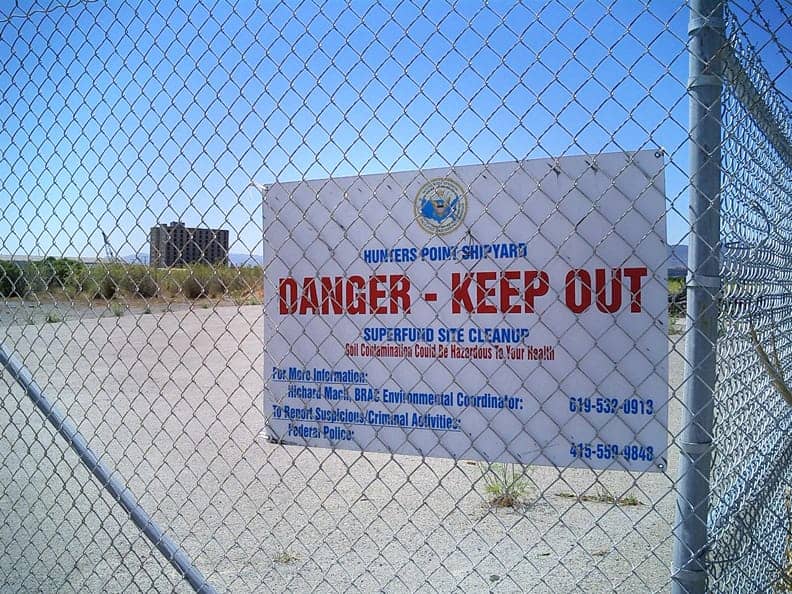
The Navy announced plans Thursday to cap toxins on one of the more highly contaminated parcels of the Hunters Point shipyard, although some of the soil with radiological contamination is slated for removal.
Along with a shoreline embankment to prevent pollution from leaking into San Francisco Bay, the measures will be enough to make the area around the former landfill site safe for human habitation, according to naval officials.
But the Navy’s proposal is not likely to satisfy environmentalists.
The Navy is cleaning up a Hunters Point parcel.
- 22 Acreage of site
- 14.5 Acreage already capped
- 30 feet Depth of potential toxins
- 1.16 million Cubic yards of excavation for complete removal of toxins


The Hunters Point Naval Shipyard covers 500 acres on San Francisco's southeastern flank, jutting out into the bay like the fletching of a giant arrow. Acquired by the U.S. Navy in 1940, it was once one of the West Coast's largest shipyards, at its World War II peak employing up to 17,000 people, many of them African Americans who settled nearby. The Navy ended its work at the Shipyard in 1974, devastating the local economy, and it was eventually listed for cleanup as a Superfund-equivalent site. These days, it's a rusting city unto itself, its drydock and warehouses abandoned. For a long time, its only tenants were the city's crime lab and artists drawn by the cheap space and haunting surroundings: a boarded-up diner, its Pepsi sign intact; the giant crane where the Navy once tested rockets; deserted labs that hosted radiological experiments.
As one of the largest chunks of vacant land left in San Francisco -- which has some of the highest land values and housing costs in the country -- the shipyard represents an immense opportunity. And so last summer, after decades of wrangling and neglect, the San Francisco Board of Supervisors approved an ambitious redevelopment plan for the site. If completed, it will be one of the largest developments here since the creation of Golden Gate Park -- and perhaps the most contentious.Read more at grist.org
The Board of Supervisors gave a unanimous OK on Tuesday to a plan to put 1,600 new condominiums and apartments in a triangular area tucked between Candlestick Park and Highway 101.
Plans call for the 70-acre site, now mostly parking lots and temporary office space, to be turned into a residential community that could eventually have more than 2,800 residential units in a number of towers, some up to 240 feet tall.
A patchwork of condominiums already has been built and will remain on the site.Read more at SFGate
A San Francisco judge has tossed out most of a legal challenge to the controversial plan to convert the shuttered Hunters Point Naval Shipyard and nearby Candlestick Point into a new neighborhood with more than 10,500 homes, clearing the way for work to begin on the project.
Superior Court Judge Ernest Goldsmith, in a 37-page ruling made public Monday, found that the environmental review for the mega-project was adequate in all regards except one: the early transfer of some parcels of the shipyard.
 From The Bay View,
The Board of Supervisors will hold a public hearing on the ethics of the Department of Public Health and the Lennar Corp. related to the department’s role regulating environmental health impacts Thursday, June 23, at 1 p.m. in City Hall, Room 263. The hearing was called in response to a community report released by Bayview Hunters Point community organizations in the SLAM Coalition earlier this spring exposing email communication the Health Department and Lennar in an effort to conceal information about adverse health impacts.More at The Bay View
The report details a series of emails since 2006 between EPA, the San Francisco Department of Public Health (SFDPH) and Lennar that reveal a manipulation of facts in order to conceal information regarding asbestos exposure from construction activities at the Shipyard and present false claims in support of Lennar’s redevelopment plan. The emails were obtained through a Freedom of Information Act request.
As state budget wrangling continues in Sacramento, San Francisco’s Redevelopment Agency is waiting for the end — or a significant change — to what it does.
The end of the agency in The City could mean the ax for nearly a dozen projects that would provide hundreds of affordable-housing units, according to Redevelopment Agency Executive Director Fred Blackwell.
Blackwell addressed the agency’s commission Tuesday to discuss the limbo condition of two state Assembly bills that passed muster with lawmakers last week, but have yet to be decided by Gov. Jerry Brown, who wants to eliminate the agencies statewide.
“The hit in San Francisco would be pretty substantial,” Blackwell said in a phone interview, noting threats to efforts such as business revitalization on Third Street in the Bayview district and a push to revamp the mid-Market Street neighborhood.
Approved by the Planning Commission, the plan to raze and redevelop the central office components of the 70-acre site adjacent to Candlestick Point with 1,600 housing units and 70,000 square feet of retail with buildings rising up to 240 feet tall is back in front of San Francisco’s Land Use and Economic Development Committee this afternoon to vote on the amendments to make it so.
With the development currently dubbed "Executive Park," as a plugged-in tipster writes: "Since the project will become mixed use, it could use a new name." That it could. And we know just who to ask.


