Despite running only 4 points behind David Chiu in the June 3 primary, D9 Supervisor David Campos has apparently fallen well behind the frontrunner Chiu in recent fundraising numbers.
According to fundraising data made public on Friday, David Chiu has 25-times the amount of money in the bank - $500,000 - as his opponent. This despite their 2014 fundraising totals seeming to be much closer - Chiu has raised $579,393 in the first six months of 2014 while Campos raised $305,571. It would appear the two Davids have run their campaigns very differently, Campos spending most of his money to ensure a good June 3 showing, while Chiu holding off spending his to bolster his run-up to the November election.
Also revealed were fundraising totals for the D10 supervisor race. According to SFGate, "Cohen brought in nearly $117,000 this year, and has $175,590 in the bank after carrying over more than $110,000 from 2013. Kelly has raised $42,135 in donations and spent nearly all of it. But he has also received nearly $84,000 in public financing and matching funds, according to his campaign." Meanwhile, "Cohen, like all of the sitting supervisors, has declined to accept public financing."

Showing posts with label election. Show all posts
Showing posts with label election. Show all posts
Tuesday, August 5, 2014

Wednesday, May 14, 2014
D10 Supervisor Race and the "United Front" against Malia Cohen
 |
| Malia Cohen |
 |
| Tony Kelly |
 |
| Marlene Tran |
Unlike Kelly, 51, who announced his campaign in February, Tran admits that her "very late entry" into the race was a "quick decision". At least for now, she seems less prepared to make a run than she did four years ago, but given her strong third place finish in 2010, the 67 year-old Tran could become a viable candidate if she applies herself over the next six months. A recent 2:30AM email from her indicates she knows that she has to "work extra hard now."
Interestingly, in posting her message to Nextdoor announcing her withdrawal from the race, Diane Wesley-Smith also announced the creation of what she calls a "United Front" of Marlene Tran, Ed Donaldson, and Tony Kelly against Malia Cohen. Although perfectly fine to do, if they truly wanted to show a united front, wouldn't rallying behind the most viable candidate be the best way to do that? Wesley-Smith's action of pulling out makes the most sense, while Tran and Donaldson appear to be spending time, energy, and possibly public money running campaigns they must know are at best long-shots to win. Why not endorse Kelly and energize their respective bases to raise money and vote for him in the #1 slot? Although it'll get their respective issues out in front of voters, instead of showing unity, this strategy may come across as fractious and even vain on their part. On the other hand, this "united front" may be their way to help Kelly engage communities where he has a perceived or real racial and/or linguistic barrier in connecting with voters who look up to Tran and Donaldson and whose appeal could help get voters to the polls. The collective wisdom of the candidates may be that Kelly has a better shot at getting a #2 vote on a Tran or Donaldson ballot than he would getting a #1 vote if it were just him up against Cohen.
Playing a purely hypothetical numbers game, in 2010 20550 voters cast ballots in the Supervisor race (I'll keep Ed Donaldson out of my calculations, as he garnered less than 1% of the total vote in 2010 and his influence on the race this year seems limited). Of those, 3330 voted Tran in the #1, 2, or 3 slot. If we assume a similar vote total in 2014, and if votes follow the same pattern as the second-to-last round of RCV in 2010, with just three main candidates we'd have Cohen 7850, Kelly 6658, and Tran 6206. If a similar proportion of Tran's votes were to go to Kelly and Cohen as they did in 2010, then Kelly would pick up about 60% and Cohen 40%. This would put them neck-and-neck, with only 50 votes between the two.
But 2010 was a race in which there was no incumbent, and everyone was, to a degree, and unknown entity. Today we have to ask, what is Cohen's incumbency advantage? The fact that she is addressed as "District 10 Supervisor Malia Cohen" at every event she attends should give her an advantage. Successes such as the new Grocery Outlet store and a preliminary agreement to put 1700 affordable homes at Schlage Lock in Visitacion Valley should help her. But if opponents are to be believed, Cohen negatives outweigh her positives, and she may be so unpopular as to not have an advantage at all. Issues like her support for redistricting Potrero Hill out of D10, Fresh & Easy closing down its Bayview store, and lack of support from many city leaders regarding a homeless shelter at Mother Brown's in Bayview are seen by opponents as a tarnish on her advantage that makes her weak.
Despite these things, a strong possibility remains that voters could ignore the tarnish and give Cohen the benefit of the doubt in November as they often do incumbents. Similarly, Tran voters could ignore or be totally unaware of her endorsement of Kelly and choose the known over the unknown in their #2 vote. Cohen's opponents are going to have to sow and grow an awful lot of doubt and discontent in the minds of a sizable chunk of voters to get them to make the leap of faith and call for a change. Doing so without sounding mean and nasty is a political knife edge they'll have to walk. Not impossible, but challenging to be sure.
Should be interesting to see what the next six months brings.
---------
Note: I was appointed by Supervisor Cohen in 2012 to the SFCTA-CAC. I will do all I can to keep my personal opinions about the race to myself, but if anything (including the above article) appear biased toward Supervisor Cohen in any way, please call me out, point out where you see the bias, and I'll endeavor to do better in the future.
Friday, January 24, 2014
CA-17 Debate
From the SF Examiner,
The CA Assembly seat they are both vying for is currently filled by Tom Ammiano, who is termed-out this November. The seat has gone through some renumbering and boundary redefining over the years, but before Ammiano, the seat was held by State Senator Mark Leno and former State Senator Carole Migden. If Chiu wins the seat, he would be the first non-LGBT person sent to Sacramento from the district since 1996, when Migden won the seat after Willie Brown let go his 30-year hold on it to become San Francisco's Mayor.
A candidate's ability to raise funds is often used as an indicator of their strength in a election. According to David Chiu's campaign, he has raised over $450,000 just in the past three months and enjoys an early 12-point lead in a poll commissioned by his campaign. However, with 38% undecided and ten months to go, either of them could end up winning the seat. It is unknown what David Campos' fundraising totals are for the same time period, but the San Francisco Young Democrats, the organization that sponsored last night's debate, voted to endorse him over Chiu.Supervisor David Campos went on the attack against board President David Chiu from the outset of Thursday night’s debate in the race for a state Assembly seat, as the candidates covered everything from Google buses to whether to let bars stay open until 4 a.m.

The CA Assembly seat they are both vying for is currently filled by Tom Ammiano, who is termed-out this November. The seat has gone through some renumbering and boundary redefining over the years, but before Ammiano, the seat was held by State Senator Mark Leno and former State Senator Carole Migden. If Chiu wins the seat, he would be the first non-LGBT person sent to Sacramento from the district since 1996, when Migden won the seat after Willie Brown let go his 30-year hold on it to become San Francisco's Mayor.
Monday, November 14, 2011
How SF's Neighborhoods Voted
Mayor Lee was the only candidate (to my knowledge) who had an office in D10, and I think I saw him here more than other candidates, so no surprise that he won in most parts of the district.
Beyond Chron has a really nice analysis of how Mayor Lee ran a citywide campaign that ultimately crushed his competition, even in their own districts.
From SFGate,
Read more at SFGate
Beyond Chron has a really nice analysis of how Mayor Lee ran a citywide campaign that ultimately crushed his competition, even in their own districts.
From SFGate,
With the exception of a small bite in Potrero Hill and adjacent Dogpatch neighborhoods on San Francisco's eastern edge - home to City Attorney Dennis Herrera, who placed third in the mayor's race - Lee got the most first-place votes in the neighborhoods that ring the city.
Among Lee's strongholds: Chinatown, the Marina, the Richmond, the Sunset, Ingleside, Visitacion Valley and Bayview-Hunters Point.

Read more at SFGate
Wednesday, November 9, 2011
Election Update
The Department of Elections just posted its first preliminary Ranked Choice Voting results:
Mayor: Ed Lee (11 Rounds)
District Attorney: George Gascón (3 Rounds)
Sheriff: Ross Mirkarimi (3 Rounds)
Mayor: Ed Lee (11 Rounds)
District Attorney: George Gascón (3 Rounds)
Sheriff: Ross Mirkarimi (3 Rounds)
Tuesday, November 8, 2011
Election Day!
From SFGate,
From Asian Week
The Bay Citizen has a pretty cool election simulator, based on their poll results that show Mayor Lee winning in nine rounds.
A familiar complaint about city elections under ranked-choice voting is that getting results takes forever. San Franciscans vote on Tuesday and it is often not until Friday that winners are declared.
From Asian Week
It is not only the residents of Chinatown but heavily populated Asian communities, such as the people of Visitacion Valley, which showed an 18 percentage point surge in voter mail-in turnout.
The Bay Citizen has a pretty cool election simulator, based on their poll results that show Mayor Lee winning in nine rounds.
RCV: A year after D10, we now see how it works (or doesn't) citywide

After the first round of RCV, there were 17808 votes in the pool. By Round 19 that had fallen to 8200. So, yes, only 46% of the ballots made it that far, and Supervisor Cohen's 4321 first, second, and third place combined votes were enough to beat Tony Kelly's 3879. In the first round, Kelly had 2102 and Cohen 2097, while Lynette Sweet had 2150, topping both of the eventual final round candidates. The point here is that Kelly and Cohen were more 'palatable' than Sweet, across the three choices. Had we had a simple runoff style election based solely on first round voting, the choice would have been between Sweet and Kelly, not Cohen and Kelly.
You've got to ask, too, how many people come out one month after having just voted for another election? Would 46% of the people who were interested enough the first time around vote again? Barely. In the last couple of elections in which we had run-off elections, voter turnout dropped roughly 50% (http://www.sfrcv.com/) between November and December.
So, in 2010, if we'd had a run-off election, it would have been between Kelly and Sweet, and perhaps 8900 people (50% of the November election) would have cast ballots. It would have been a close election, and whoever won would have done it with somewhere slightly over 4450 votes. While we would have ended up with someone different, the vote tally that got them there would have been nearly the same as using RCV.
RCV isn't perfect, it's made out to be more confusing than it really is, but does it lead to voter suppression, or your vote not counting in the end? Maybe. If we didn't have RCV during the 2010 election, people who voted for any one of the candidates who didn't end up in the run-off would be given the chance to choose again in December between the remaining highest vote-getters. With RCV, people who voted for a losing candidate the first time and whose ballots were exhausted were not given the chance to select their preference from the remaining candidates. In the end, 9600 voters for whom neither Kelly nor Cohen was their choice are left with a supervisor they didn't put in their top three. So did 4300 voters override the 9600 to put Cohen in office? Seems that way to me, but I could be wrong.
I suspect the bottom line is that 3-choice RCV works for a small number of candidates, but for the numbers we saw in D10 last year and in the Mayor's race this year, it falls apart. Perhaps RCV should be changed so that when the number of candidates is below 10, you get three choices; below 20, you get four; above 20, you get five choices.
Wednesday, September 14, 2011
EVENT: SF Mayor's Debate at Bayview Opera House, Tomorrow night
A reminder that tomorrow night at the Bayview Opera House, 6PM, the Harvey Matthews Bayview Democratic Club will be hosting a mayoral debate, featuring (updated):
Former Supervisor Michela Alioto-Pier
Supervisor John Avalos
Supervisor David Chiu
Former Supervisor Bevan Dufty (recently profiled - with a D10 shout-out - in SFGate)
District Attorney Dennis Herrera (a D10 resident)
Interim Mayor Ed Lee
Joanna Rees
Not attending, but sending a representative will be State Senator Leland Yee
Thursday, July 14, 2011
Three on Redistricting Panel
From Asian Week,
Marily Mondejar Pays to Have an Asian Mayor: After the SF Department of Elections shutout Asian Pacific Americans from the crucial SF Redistricting Task Force, Mayor Ed Lee made it up last Friday by appointing Myong Leigh, SF Unified School District Deputy Superintendent, and Marily Mondejar, Filipina Women’s Network president. The nine-member panel oversees the equitable redistribution of residents for the city’s 11 supervisor districts after the 2010 US Census. The outcome could be supervisor districts that could increase or decrease APA representation, comprising more than one-third of SF residents. The task force will need to consider past political gerrymandering like the dilution 10-years ago shifting APA Portola residents into Supervisor David Campos’ heavily Latino District 9 (Mission) from the emerging APA District 10 (Bayview/Visitacion Valley) represented by Malia Cohen or the heavily APA District 11 (Ingleside/Outer Mission) seat held by John Avalos. In its three appointments last June, the SF Board of Supervisors selected Jenny Lam of Chinese for Affirmative Action to the panel that will determine political boundaries for the next ten years…

Friday, March 11, 2011
S.F. ranked-choice mess looms for mayor's race
From SFGate,
Read more at SFGateWe may be headed for a ballot box train wreck. November's election will technically be the first mayoral election to be decided by controversial ranked-choice voting. (Gavin Newsom was essentially unopposed when he was re-elected mayor.)
Today's Chamber of Commerce survey shows that voters find ranked-choice confusing and unsettling and would prefer a traditional two-candidate runoff. There's even been talk of repealing ranked-choice voting at the ballot box.
Good luck with that.

San Francisco supervisor districts poised to change now that census data is released
From SF Examiner,
Read more at the San Francisco ExaminerWith new census data come new population counts. And with new population counts comes redistricting. And with redistricting comes politics.
Click on the photo to the right for more census data.
Let the line-drawing begin.
City elections chief John Arntz informed supervisors this week that he’ll be looking at population changes within their districts.
The City’s charter now gives him 60 days to decide whether populations have changed substantially. If they have, the board convenes a committee to redraw districts for the 2012 elections.
Observers are already eyeing the process, and considering how it could change The City’s balance of power.

Tuesday, March 8, 2011
San Francisco Mayor’s Race is Off and Running
From Beyond Chron,
Read more at BeyondChronIt’s eight months before San Francisco’s mayoral election, with the eventual winner already in the field. While a candidate identified with the city’s political Left still may emerge, the current frontrunners are Board of Supervisors President David Chiu, City Attorney Dennis Herrera, and State Senator Leland Yee. Former Supervisors Bevan Dufty and Michela Alioto-Pier and Assessor Phil Ting will shape the outcome due to ranked choice voting, but none have reached the top tier. This is the first time since 1975 where there is no clear favorite in the Mayor’s race, but keep in mind that Jack Molinari in 1987 and Art Agnos in 1991 were heavy favorites in March and both lost. Here’s my assessment of the major upsides and challenges affecting the three current leading contenders.

Wednesday, January 12, 2011
Yee Seeks 'Truth in Naming' on Election Ballots - Bay Citizen
From the Bay Citizen,
State Sen. Leland Yee has reintroduced a bill that would require candidates for elected office to use an accurate phoenetic interpretation of their name when it appears on Chinese, Korean or Vietnamese-lanugage ballots.
The bill comes amid concern that more and more non-Asian candidates are listing Chinese names on San Francisco ballots in an effort to appeal to the city's growing block of Chinese voters.
In this past election, for example, Malia Cohen, who was recently elected supervisor in San Francisco's District 10, was listed as "Kuo Han" on Chinese-language ballots.
Michael Nava, a third-generation Californian of Mexican descent running to become a judge on the San Francisco Superior Court, called himself Zheng-Ping Lee on the ballot. (Nava lost to Richard Ulmer).
In a statement, Yee said his bill, SB 88, "attempts to stop the last-minute, deceptive practice of using a fake name simply to deceive Asian voters to win an election."
Yee introduced a similar bill in the last legislative session, but it was vetoed by then-Gov. Arnold Schwarzenegger.
"This unscrupulous practice should be prevented," Schwarzenegger wrote, "however, a change in state policy is unnecessary. Under current law, local election officials have the authority to address this fraudulent behavior and to set policies that are appropriate for their unique jurisdictions. For example, the director of elections in San Francisco has established a Chinese name translation policy to address concerns that improper translations were being used by candidates in local races.”

Friday, January 7, 2011
Low-income voters struggled with ranked-choice voting - California Watch
From California Watch,
Voters from low-income neighborhoods had a tougher time with the complexities of the ranked-choice voting system in November's election.
That’s the bottom line of a California Watch analysis of voting data from the electoral district that arguably faced the most complicated ballot in California: San Francisco’s Supervisorial District 10.
In the first round of the system’s so-called instant runoff, more than 2 percent of district voters – 489 – spoiled their ballots with what are called “overvotes.” That means voters improperly voted for more candidates than allowed. Under the rules, those votes weren’t counted.
Although the voters who didn’t vote in the supervisorial election were distributed fairly evenly throughout the district, the “overvotes” were concentrated in lower-income areas, the data show.
In Bayview/Hunters Point, more than 3 percent of the ballots were spoiled because of overvotes. The rate was almost as high in Visitacion Valley, a lower-income area with a large population of Asian immigrants.
Those rates were triple the spoil rate among votes cast on Potrero Hill, where income and education levels are higher, according to census data.
Saturday, January 1, 2011
When 0.45% of Total Voters Can Translate to Victory - NY Times
Scott James of the New York Times/Bay Citizen writes,
If the new San Francisco Board of Supervisors sworn in Jan. 8 is anything like its predecessor, there will be a time when an unpopular decision will have citizens asking, “Who picked these people?”
The answer will be: hardly anyone.Read more at NY Times
A record 8 of 11 supervisors on the new board have an interesting distinction: They were not the first choices of a majority of voters, but prevailed in the city’s ranked-choice voting system.
Thursday, December 9, 2010
Class of 2010: Malia Cohen - SFBG
Sarah Phelan at the SF Bay Guardian writes,
Can a winner who lost the first-place vote in D10 be a bridge builder?
It took two weeks and 19 updates of San Francisco's ranked-choice voting system before Malia Cohen, a former Mayor Gavin Newsom staffer and partner in a firm that helps businesses and nonprofits create public policy, was declared the winner of the hotly contested race to represent District 10, which includes Bayview, Hunters Point and Ingleside. The nail-biting time lag was a byproduct of complex calculations that involved 22 candidates, no clear front-runners, and a slew of absentee and provisional ballots.

But when the RCV dust settled, the results proved that the D10 vote continues to break down along class, race, and gender lines. These RCV patterns personally benefited Cohen's success in picking up second- and third-place votes.Read more at the SFBG
Wednesday, December 8, 2010
Steve Moss' Election Wrap, Part 1 - The Potrero View
In this month's Potrero View, Steve Moss writes,
Last month District 10 voters elected a new Supervisor: Malia Cohen. In a hotly contested race, in which Lynette Sweet won the most first place votes, Cohen elbowed past her initial third place position to emerge the winner through the ranked choice voting process. In the final tally just one-fifth of the voters identified Cohen as one of their three choices, enough for her to edge out Tony Kelly, who received the second most first place votes.

The election results tell a chaotic tale of a district in search of an identity. The two Asian-American candidates, Marlene Tran and Teresa Duque, gathered more than 3,400 votes between them, reflecting a new, powerful, ethnic voting bloc. Kelly beat me in Potrero, but didn’t crack the top five vote-getters in the district’s other three dominant communities: Bayview-Hunters Point, Visitacion Valley, and Portola. Cohen won without strong support from the Hill – she was sixth in terms of first place votes from our community – suggesting a political tilt towards the district’s southern neighborhoods. More than 2,500 District 10 voters either didn’t select a supervisorial candidate, or spoiled their ballot by marking multiple politicians as their first choice. If these individuals had properly voted or participated in the supervisors’ race they’d have changed the outcome.Read more at the Potrero View
Wednesday, November 24, 2010
That was close!
With Steve Cooley's concession in the Attorney General race, the question now is, who's going to fill out Kamala Harris' term as SF District Attorney?
Writes Marisa Lagos at the Chronicle,
Writes Marisa Lagos at the Chronicle,
Harris' replacement could be appointed by Newsom, if he waits to resign after she vacates the district attorney's office. Otherwise, an acting or interim mayor would choose the city's next prosecutor, until voters weigh in next November.
“I Heard That”: Bravo to 3 Dynamic Women - Beyond Chron

"Cohen is a San Francisco native, has worked for Mayor Gavin Newsom, and as a policy analyst for the federal government. This young woman has a bright future. Active in the Democratic Party; received major endorsements in her first run for political office (the youngest to run in Dist. 10)."
Read more at Beyond Chron
Understanding D10 RCV Election Results - Fog City Journal
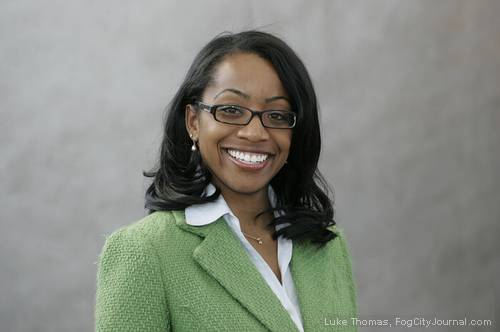
Though the results in the ranked-choice race for District 10 Supervisor have not been officially certified by the San Francisco Department of Elections, Malia Cohen, a liberal Democrat, is the presumed Supervisor-elect for the District.Read more at Fog City Journal and FairVote
Subscribe to:
Posts (Atom)